Ghana Passes Virtual Asset Law: What It Means for Young Investors and the Future of Digital Finance
Accra, Ghana
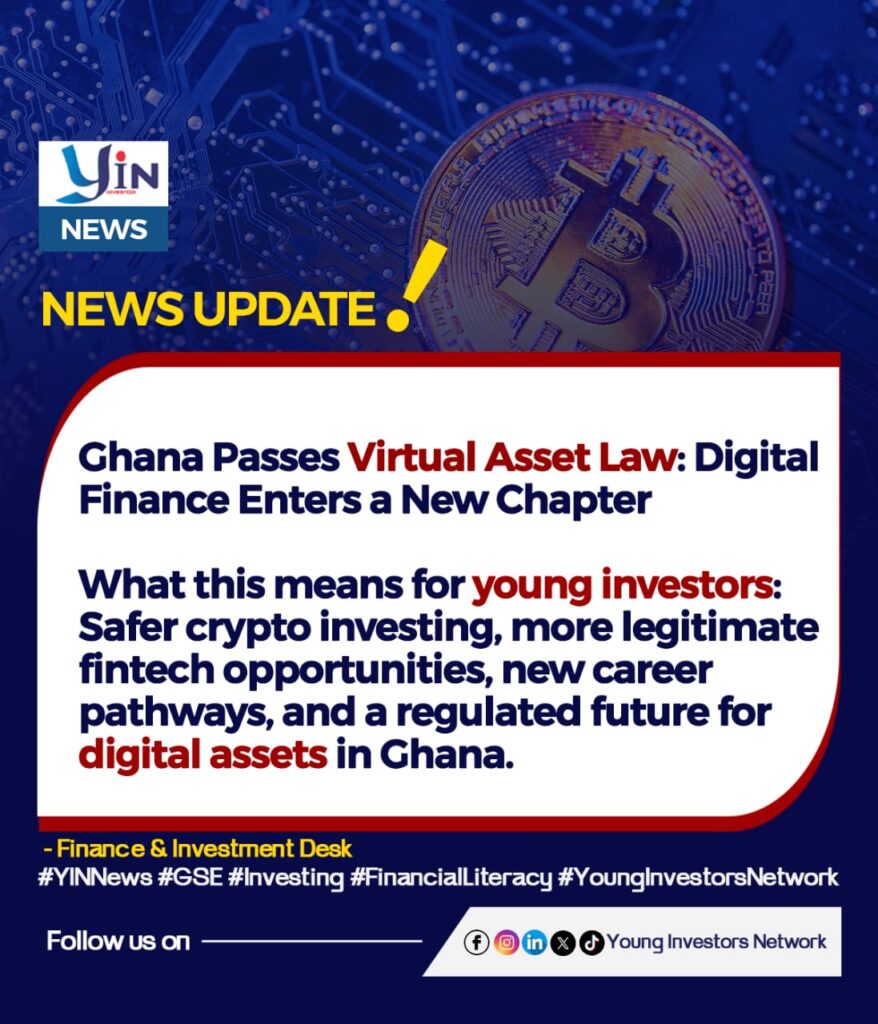
Ghana has taken a major step into the future of finance with the passage of the Virtual Asset Service Providers (VASPs) Bill, a landmark law that establishes a formal legal and regulatory framework for virtual assets and digital asset businesses in the country.
The new law officially brings activities such as cryptocurrency trading, digital token issuance, virtual asset exchanges, and related services under the supervision of the Securities and Exchange Commission (SEC) and the Bank of Ghana, marking a decisive move to regulate — rather than restrict — the fast-growing digital asset space.
Explaining the significance of the law and the concept of virtual assets, the Deputy Director-General of the SEC, Mr. Mensah Thompson, recently addressed the public in an educational video aimed at demystifying digital assets.
Mr. Thompson described virtual assets as digital representations of value that can be stored, transferred, traded, or invested through digital technologies such as blockchain. To make the concept easier to understand, he compared virtual assets to mobile money — a system already familiar to millions of Ghanaians.
Just as mobile money represents value in digital form and allows people to send and receive money electronically, virtual assets also represent value digitally and can be transferred or traded through online platforms.
He noted that virtual assets include cryptocurrencies, digital tokens, and other blockchain-based instruments that are increasingly being used by individuals and businesses. However, until now, many of these activities have existed outside a clearly defined regulatory environment in Ghana.
With the rapid rise in digital asset usage — running into billions of dollars in transaction volumes — Ghana’s financial authorities opted to regulate the ecosystem rather than ban it, creating a structured framework that promotes innovation while prioritizing investor protection, transparency, and market integrity.
Under the new VASP law, all persons and entities providing virtual asset services will be required to be licensed or registered by either the SEC or the Bank of Ghana, depending on the nature of their operations. This includes virtual asset exchanges, trading platforms, token issuers, asset managers, investment advisors, and related service providers.
According to Mr. Thompson, this approach ensures that digital asset services in Ghana will operate with greater accountability, professionalism, and consumer safeguards, while supporting the development of a credible and sustainable digital economy.
The framework is designed not only to protect investors, but also to support innovation, growth, and the long-term development of Ghana’s digital financial ecosystem.
What This Means for Young Investors
For Ghana’s youth — who form a significant portion of digital asset users — the passage of the VASP law signals a major turning point.
The new regulatory environment promises safer crypto and digital asset investing, reduced exposure to fraudulent platforms, and greater confidence in licensed operators. It also opens the door to legitimate fintech and blockchain opportunities, including new careers in digital finance, compliance, technology, data systems, and asset management.
Additionally, regulation creates pathways for the development of structured digital investment products, such as professionally managed virtual asset funds and exchange-traded products, positioning young people to participate in the digital economy in a more informed, responsible, and sustainable way.
While the law strengthens protection, experts caution that education and discipline remain essential. Regulation does not eliminate risk, making financial literacy, due diligence, and long-term thinking more important than ever.
As Ghana’s digital finance ecosystem matures, the message to young investors is clear: the future is digital — but success belongs to those who combine opportunity with knowledge, structure, and sound decision-making.